What Is an XR Piano Performance Assist App? A Complete Breakdown of "Sigure," Compatible with the Meta Quest 3
Tomo
XR Piano
For those who’ve ever wondered, “Can piano practice only happen at home?”
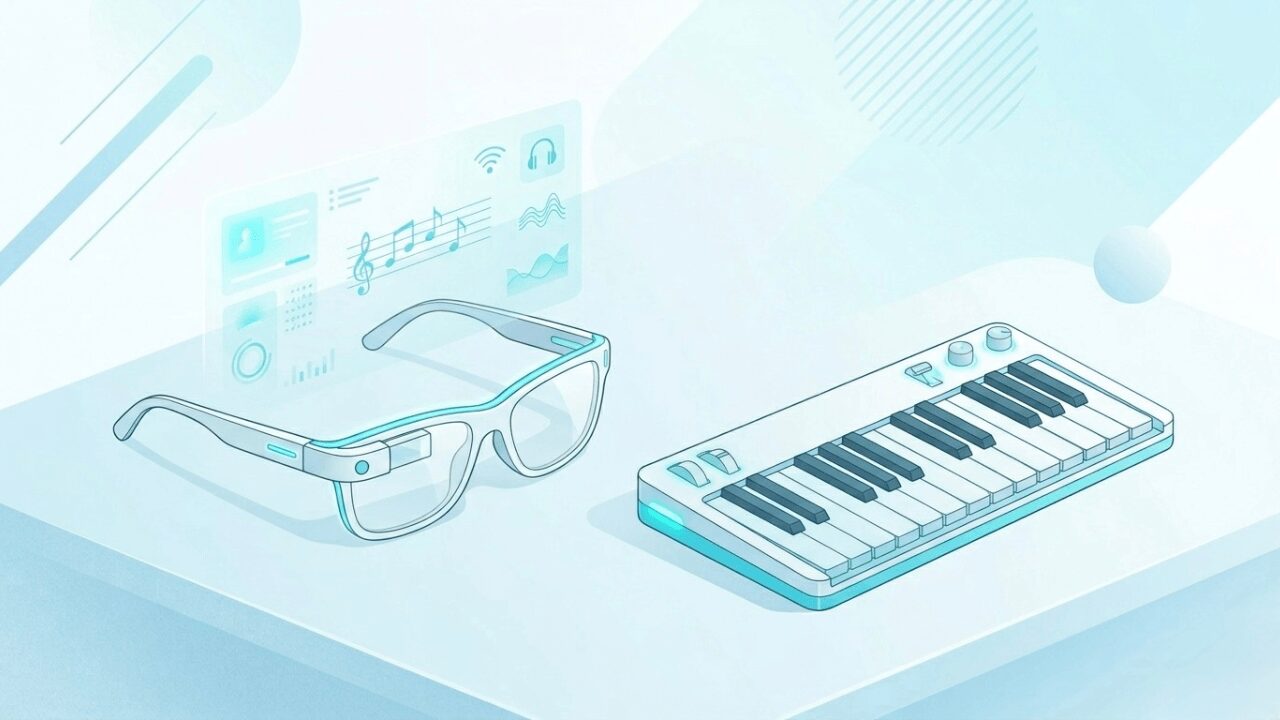
In this article, we’ll explain the current state of “practice anywhere” made possible by combining foldable pianos and MIDI keyboards with XR devices, as well as a glimpse of the future where you might be able to play piano with nothing but a pair of XR glasses.
Traditionally, piano practice could only happen wherever a piano physically was. Even with a digital piano, it was simply assumed that you’d keep it at home and practice there.
However, the combination of XR technology and portable keyboards has the potential to fundamentally change this “location constraint.”
When we run hands-on demo events for Sigure, we bring along a Meta Quest 3 and a foldable piano. In the future, we believe it’ll become possible to play piano with nothing but XR glasses, no physical piano required — and we’re looking forward to that future arriving as soon as possible.
Currently, Sigure supports the Meta Quest 3 / 3s, and is used by connecting it to a MIDI-compatible digital piano with a cable.
Beyond a large digital piano at home, using a compact foldable piano or a MIDI keyboard lets you carry your practice environment around more easily.
A foldable piano is a compact digital piano whose keyboard section can fold into two or three pieces.
While offering a feel close to a regular digital piano, it becomes compact when stored, making it easy to carry around. Any model with MIDI output support can be connected to Sigure.
A MIDI keyboard has no built-in sound source and is specialized purely for sending MIDI signals. Many compact models with 25 or 49 keys exist, and some are lightweight enough to fit in a backpack.
You connect it to Sigure using a USB-MIDI cable. For practice purposes, we recommend a model with 61 or more keys, since it can cover the full range of notes in most songs.
If you prioritize key feel, a foldable piano is the better fit; if portability comes first, a MIDI keyboard is better suited. Either one can be connected to Sigure as long as it supports MIDI output.
Since the Meta Quest 3 is a standalone device, you don’t need a PC or any large equipment.
By packing a foldable piano or MIDI keyboard, a MIDI cable, and a Meta Quest 3 into a single case, it’s entirely possible to bring your practice environment along to a friend’s house, your hometown, a business trip, or anywhere else away from home.
Your hometown or a friend’s house
By bringing along a foldable piano and a Meta Quest 3, you can practice exactly the same way as at home, even at your hometown or a friend’s place. Ideal for anyone who doesn’t want to interrupt their practice routine.
A hotel during a business trip or vacation
Many MIDI keyboards are small enough to fit in a suitcase, letting you set up a practice environment even in a hotel room. Great for anyone who wants to keep practicing during a long trip.
A room with limited space
Even in a small studio apartment, a foldable piano can be unfolded just when you need it and packed away the rest of the time. Being able to store it compactly when not in use is a big advantage.
Today’s XR piano assumes a combination of a headset device like the Meta Quest 3 and a physical keyboard, but as XR technology continues to advance, it’s believed that the future may bring an era where “you no longer need to carry a keyboard at all.”
A virtual piano refers to a keyboard displayed within the virtual space of XR glasses or a headset. There’s no physical piano at all — a virtual keyboard is projected onto any flat surface, such as a table or the floor, and you play by tapping it with your fingers.
Once spatial recognition technology and finger-tracking accuracy become sufficiently advanced, simply putting on a pair of XR glasses could turn the table in front of you into a piano, anytime. That future is getting closer.
Simply put on your XR glasses and place your hands on a café table, and a virtual keyboard appears, letting you practice along with the note guide. To everyone around you, it would just look like you’re touching a regular table.
No keyboard, no cables needed. Just carrying a single pair of XR glasses sets up a piano practice environment anytime, anywhere. Spare minutes during your commute or school run could become practice time.
A full-size grand piano displayed in virtual space, combined with realistic acoustic simulation for an authentic playing experience. Even in a small room, you could experience the feel of a concert hall piano.
There are still technical challenges to solve before a virtual piano can become reality — finger-tracking accuracy, haptic feedback, and the stability of spatial recognition, to name a few. That said, given the pace at which XR technology is advancing, we believe it’s entirely plausible that it could reach a practical level within just a few years. Sigure continues to be developed with that future in mind.
Choose a foldable piano or MIDI keyboard model that supports MIDI output. If portability is your priority, a 61-key MIDI keyboard is a good fit; if key feel matters more, a foldable piano is recommended.
Having a case that holds your Meta Quest 3, keyboard, and MIDI cable together lets you start practicing right away wherever you go.
Once you’ve installed Sigure from the Meta Quest Store, you’re ready to go. After launching the app and calibrating, you’ll have the same practice environment as home, no matter where you are.
A. If key feel matters most, a foldable piano is the better choice. If you just want something as light and compact as possible, a MIDI keyboard is recommended. Either type can be connected to Sigure as long as it supports MIDI output.
A. This is still in the research and development stage at this point. If finger-tracking accuracy and haptic feedback technology mature, it could approach a practical level within a few years. Sigure also continues development with future support for this in mind.
A. We recommend a model with 61 or more keys to cover the range of notes used in most songs you’ll practice. While 25- or 49-key models are highly portable, they limit the range of songs you can play.
Let’s start XR piano with the best setup available today.
“Just put on a pair of XR glasses, and the table in front of you becomes a piano.” Bringing that experience to life is one of the futures we’re working toward.
For now, a Meta Quest 3 / 3s and a physical keyboard are still required, but as technology advances, those constraints will gradually fall away. For now, experience the joy of XR piano in the form available today, and let’s head toward that future together.